How to Understand Caitlin Clark Injury Risks and Her Recovery Protocol
When basketball fans hear about a possible Caitlin Clark injury, panic ripples through the arena immediately. She plays an intense, fast-paced brand of basketball that exposes her body to serious physical stress every single quarter.
Staying healthy in modern professional sports requires relentless effort behind closed doors. Any minor Caitlin Clark injury concern sparks breaking news alerts across sports networks and social media feeds worldwide.
This breakdown reveals her physical conditioning routines, her past health scares, and the smart recovery tactics protecting her from long-term sideline spells.
Player Profile and Caitlin Clark Injury Risk Factors
Caitlin Clark transitioned from a legendary collegiate run at Iowa directly into the intense spotlight of the WNBA. Since being drafted first overall by the Indiana Fever, her workload has been exceptionally demanding.
Her signature style relies on sudden deceleration, rapid changes of direction, and deep three-point shooting. These high-impact mechanics place massive torque on her lower extremities during every single possession.
To evaluate her long-term physical resilience, we must examine her background, athletic measurements, and daily on-court demands.
| Metric / Attribute | Player Profile Detail | Biomechanical Risk Factor |
| Height | 6 Feet 0 Inches | Higher center of gravity on hard lateral cuts |
| Primary Position | Point Guard | Constant ball-handling under aggressive defensive pressure |
| Pro Draft Year | 2024 (Round 1, Pick 1) | Zero extended off-season rest between college and pros |
| College Program | Iowa Hawkeyes | Exceptionally high offensive usage rate over four years |
| Current Team | Indiana Fever | Faces heavy physical contact from veteran defenders |
This baseline data explains why her athletic training staff prioritizes joint preservation above everything else. Standing six feet tall at the point guard spot provides unmatched court vision, but it also increases leverage forces across her knees.
The immediate shift from college tournament play to professional training camps meant her muscles had no downtime to rebuild naturally. Managing this heavy load is what keeps her performing without experiencing physical burnout.
Reviewing Past Caitlin Clark Injury Scares on the Hardwood
Throughout her rise to superstardom, a few scary moments have caused Indiana Fever coaches and fans to hold their collective breath. During her rookie season, minor ankle tweaks sent her limping toward the team bench for immediate medical evaluation.
Fortunately, these incidents turned out to be mild joint rolls rather than severe ligament tears. Every reported Caitlin Clark injury scare has demonstrated her natural physical resilience and rapid healing capacity.
Understanding the specific physical threats she faces during games helps highlight the protective measures her team puts in place.
Ankle Instability and Lateral Cutting Demands
Step-back jumpers and rapid crossover dribbles generate high lateral torque on the outer ankle ligaments. When a defender steps into her landing space, the probability of an inversion sprain rises quickly.
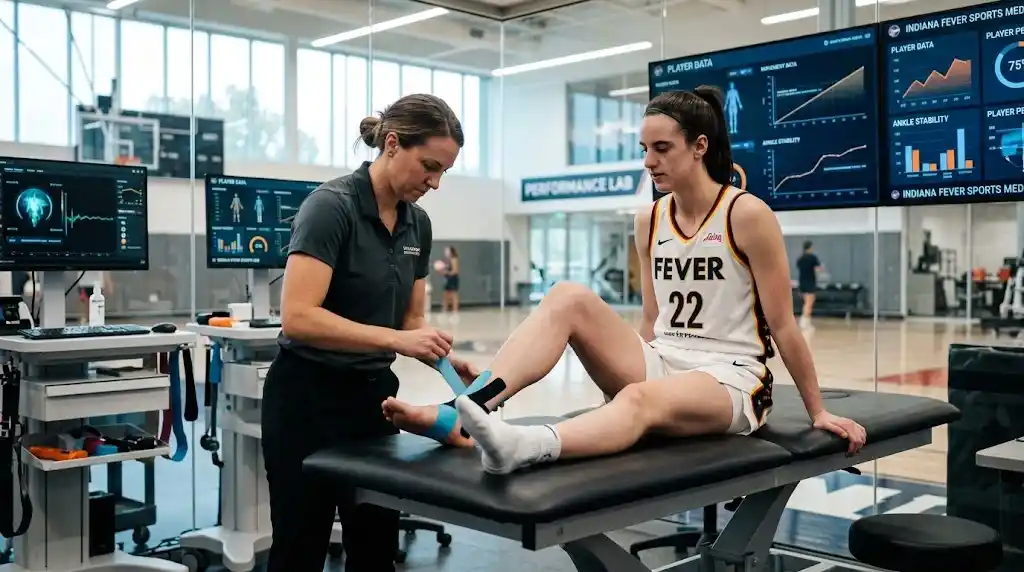
Her performance staff uses customized dynamic taping methods and balance drills to reinforce joint stability before every tip-off. This extra support keeps her ankles protected without reducing her signature quickness.
Managing Muscular Fatigue and Tight Game Schedules
A relentless travel schedule and back-to-back games leave very little room for natural muscle tissue repair. Chronic fatigue stands as the primary culprit behind any unexpected Caitlin Clark injury involving soft tissues.
To fight fatigue, her training team uses compression boots, specialized hydration plans, and cold-water therapy immediately after games. Flushing out metabolic waste keeps her muscle fibers elastic and responsive.
Sports Science Protocols Preventing Serious Caitlin Clark Injury Issues
Preventing athletic downtime requires cutting-edge biometric tools paired with personalized strength training. Medical staff members track her on-court movement velocity and force output using wearable GPS units during practices.
These digital sensors alert the medical team when her running stride shows minor asymmetries. Spotting these small movement hitches early prevents a minor Caitlin Clark injury from developing into a chronic condition.
Here are the primary components of her weekly injury prevention routine:
- Single-Leg Stability Drills: Enhances balance on uneven landings to safeguard knee ligaments.
- Posterior Chain Strengthening: Builds powerful hamstrings and glutes to absorb sudden stopping forces.
- Dynamic Hip Mobility Routines: Keeps the pelvic region loose so force does not transfer directly into the lower back.
- Regulated Cold Hydrotherapy: Lowers systemic inflammation across all working joints within thirty minutes of game completion.
Why the WNBA Cannot Afford a Caitlin Clark Injury Sidelining
An extended absence for a superstar player affects far more than just the win-loss record of the Indiana Fever. Television viewership numbers, arena ticket sales, and merchandise demand are tied directly to her active participation.
Because the stakes are so high, team medical personnel treat every potential Caitlin Clark injury indicator with maximum seriousness. Her continued health remains an economic driver for women’s professional sports.
Investing in state-of-the-art sports science ensures that the league’s most visible athlete stays healthy, active, and performing at her highest level.
Frequently Asked Questions About Caitlin Clark Injury Status
Has a major Caitlin Clark injury occurred in her basketball career?
No major structural tears or broken bones have occurred during her collegiate or professional career. Her durability stems from elite conditioning, consistent functional strength workouts, and proactive physical therapy routines. She has only experienced brief, minor ankle rolls that resolved quickly.
How do trainers reduce Caitlin Clark injury risks during back-to-back games?
The training staff monitors her physical output through wearable biometric tracking sensors during every game. If movement data shows unusual fatigue, her practice workload is reduced immediately to prevent excessive muscle strain. Post-game physical therapy and contrast baths are also mandatory.
What specific exercises help avoid a Caitlin Clark injury on court?
Her exercise routine includes Romanian deadlifts, Bulgarian split squats, and balance board stability drills. These movements strengthen the stabilizing muscles surrounding the knees and ankles. Developing strong connective tissues protects her joints from unexpected landing impacts.
Did any collegiate Caitlin Clark injury slow down her Iowa career?
She maintained an exceptional attendance record throughout her four years with the Iowa Hawkeyes. Despite playing heavy minutes against physical defenses, she avoided major sideline stints. Her consistent availability helped lead her team to consecutive national title appearances.
How does ankle taping prevent a Caitlin Clark injury during step-backs?
Specialized athletic taping locks the subtalar joint in place to reduce extreme outward rolling during sudden stops. It provides external support while still allowing full upward and downward foot motion for natural shooting mechanics.
What makes a Caitlin Clark injury topic trend so fast on social media?
Her global popularity and massive influence on WNBA viewership turn any health update into major sports news. Millions of fans and analysts track her status closely because her presence directly shapes the competitive landscape of the league.
The Final Take on Her Athletic Durability
Maintaining elite performance under intense physical pressure is the ultimate challenge for modern basketball stars. Her structured approach to fitness proves that joint preservation and strength development are top career priorities.
By pairing world-class training science with natural athletic toughness, she continues to avoid major setbacks. Basketball fans can look forward to seeing her dominate the court for many seasons to come.